Meet FunctionGemma: Turn Natural Language into Executable Function Calls

FunctionGemma translates what you type into a predictable function call format that programs can execute. Stop parsing unpredictable AI responses. Start building reliable automation with FunctionGemma.

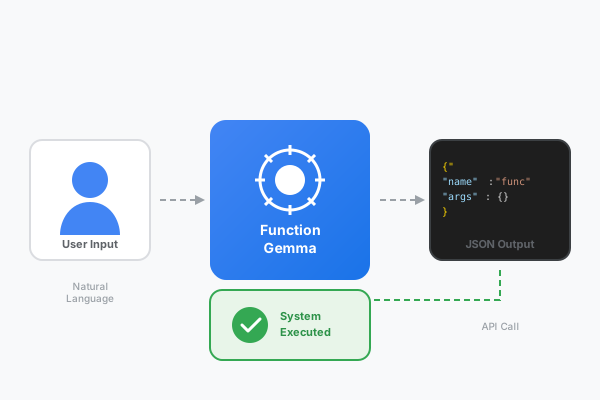
FunctionGemma workflow: User input flows to FunctionGemma, which outputs structured JSON for system execution

What is FunctionGemma?

FunctionGemma is a specialized version of Gemma 3 270M, fine-tuned specifically for function calling tasks.

The Bridge Between Human Language and Machine Actions

Most AI models produce free-form text. That works great for chatting, but it creates problems when you need software to take real actions. How do you parse "Sure, I can check the weather for you! It looks like New York is experiencing..." into something a program can use?

FunctionGemma solves this problem. Instead of generating conversational responses, FunctionGemma produces structured JSON function calls with clear parameters. When you tell FunctionGemma to "check the weather in New York," it outputs a machine-readable instruction that your system can execute immediately.

Built on Google's Gemma 3 architecture, FunctionGemma maintains the language understanding capabilities of larger models while being optimized for a specific task: converting natural language into actionable function calls. This focus makes FunctionGemma both accurate and efficient.
Key Characteristics of FunctionGemma

  • Specialized for function calling, not general chat
  • Outputs structured JSON with function names and arguments
  • Compact 270M parameter model runs locally
  • Designed for fast, private, edge deployment
  • Compatible with Hugging Face Transformers
  • Works with JSON schemas or Python function definitions

Why FunctionGemma Matters

Traditional AI outputs create real challenges for developers building automated systems. FunctionGemma addresses these pain points directly.

Unpredictable Outputs Break Integrations

Free-form AI text varies wildly between requests. The same question might produce completely different response structures, making it nearly impossible to build reliable integrations. FunctionGemma produces consistent, predictable JSON every time, so your parsing code actually works.

Parameter Chaos Causes Errors

When AI models describe actions in natural language, extracting the right parameters becomes guesswork. Is the date "tomorrow" or "2024-01-15"? FunctionGemma maps user intent to structured arguments, eliminating ambiguity and reducing integration errors significantly.

Debugging Natural Language is Hard

When something goes wrong with a conversational AI response, tracing the error back to its source is tedious. With FunctionGemma, you get clean JSON outputs that are easy to log, inspect, and debug. The structured format makes troubleshooting straightforward.

Manual Parsing Wastes Engineering Time

Teams spend countless hours writing regex patterns and parsing logic to extract meaning from AI responses. FunctionGemma eliminates this busywork by providing the structure upfront. What used to require complex parsing now requires simple JSON access.

Large Models Aren't Always Practical

Many function-calling solutions require massive cloud-hosted models with latency and privacy concerns. FunctionGemma's compact size means you can run it locally, on edge devices, or in privacy-sensitive environments without sacrificing capability.

See FunctionGemma in Action

Watch how FunctionGemma transforms natural language into structured function calls. Select an example below to see the input, the JSON output from FunctionGemma, and how your system would respond.

You Say

"Check today's weather in New York and summarize it."

FunctionGemma Output

{
  "name": "get_weather",
  "arguments": {
    "location": "New York",
    "date": "today"
  }
}

System Action

🌤️

Calls weather API to fetch current conditions for New York, then formats a summary.

This is an example output. The live interactive FunctionGemma playground is coming soon.

How FunctionGemma Works

FunctionGemma follows a simple four-step process to transform your words into actions.

1

Natural Language Input

You express your request in plain English. No special syntax required. Just describe what you want to happen, and FunctionGemma understands your intent.

2

Structured Parsing

FunctionGemma analyzes your request and maps it to the appropriate function from your defined tool schema. It extracts relevant parameters automatically.

3

JSON Function Call

FunctionGemma outputs a clean JSON object containing the function name and structured arguments. This output is ready for your system to process.

4

System Execution

Your application takes the FunctionGemma output and executes the corresponding action. The structured format makes integration seamless and reliable.

What Can You Build with FunctionGemma?

FunctionGemma enables a wide range of applications where natural language needs to trigger real actions.

🤖

AI Agents & Assistants

Build autonomous agents that understand user requests and take appropriate actions. FunctionGemma provides the reliable function-calling backbone your agent needs.

🎙️

Voice & Text Control

Create voice assistants and chatbots that actually do things. FunctionGemma converts spoken or typed commands into executable instructions for your application.

🎫

Customer Service Automation

Automate support workflows by turning customer requests into ticketing actions, lookups, and resolutions. FunctionGemma helps route and process inquiries automatically.

📊

Data Queries & Reports

Let users request data in natural language. FunctionGemma translates questions like "show me last month's sales" into structured database queries.

🏠

Smart Home & IoT

Control devices with natural commands. FunctionGemma converts "turn off the living room lights" into the exact API call your smart home system needs.

🔗

API Orchestration

Coordinate multiple services with natural language. FunctionGemma can determine which APIs to call and with what parameters to fulfill complex requests.

Workflow Automation

Trigger business processes with simple commands. FunctionGemma bridges the gap between human requests and automated workflow execution.

📱

Edge Computing

Run FunctionGemma locally on edge devices for privacy-sensitive applications. The compact model size makes on-device deployment practical.

Frequently Asked Questions About FunctionGemma

Common questions about FunctionGemma, function calling, and how to get started.

FunctionGemma is a specialized AI model that takes your everyday language and converts it into a structured format that computers can execute. Instead of getting a conversational response like "Sure, I'd be happy to help you with that!", you get a precise function call with clear parameters that software can act upon immediately. Think of FunctionGemma as a translator between human intent and machine instructions.
No, FunctionGemma is not designed for open-ended chat or conversation. While traditional chat models like ChatGPT or Claude produce free-form text responses, FunctionGemma is optimized specifically for function calling. It outputs structured JSON that represents executable actions, making it ideal for automation, agents, and integration scenarios where you need predictable, actionable outputs rather than conversational replies.
FunctionGemma outputs structured JSON containing a function name and its arguments. For example, if you say "Check the weather in Tokyo," FunctionGemma returns something like: {"name": "get_weather", "arguments": {"location": "Tokyo", "date": "today"}}. This predictable, machine-readable format makes integration with your existing systems straightforward. The exact structure follows standard function-calling conventions.
Yes, absolutely. FunctionGemma is designed specifically for local and edge deployment. Built on Gemma 3 with only 270 million parameters, FunctionGemma is small enough to run on consumer hardware, laptops, and edge devices. This makes FunctionGemma perfect for privacy-focused applications, offline scenarios, and situations where sending data to external servers isn't acceptable. You can run FunctionGemma using Hugging Face Transformers or Ollama.
Standard Gemma models are general-purpose language models designed for a variety of text generation tasks including summarization, translation, and conversation. FunctionGemma, however, is specifically fine-tuned for function calling. This specialization means FunctionGemma excels at understanding user intent and mapping it to predefined tool schemas with high accuracy. While a standard Gemma model might describe an action, FunctionGemma produces the structured call to execute it.
Function calling is the ability of an AI model to recognize when an external tool or API should be invoked and to provide the correct parameters for that invocation. This capability bridges the gap between natural language understanding and real-world actions. With function calling through FunctionGemma, you can build AI systems that actually do things - send emails, query databases, control devices - rather than just talk about doing them. It's what makes AI agents practical and useful.
For the demo on this page, no API key is needed - it shows example outputs to illustrate how FunctionGemma works. To run FunctionGemma yourself, you can download the model from Hugging Face and run it locally without any API key requirement. If you choose to use a cloud-hosted version through Google Cloud or another provider, authentication may be required depending on their specific setup.
FunctionGemma is ideal for any application where natural language needs to trigger specific, structured actions. Popular use cases include AI agents and assistants, voice-controlled applications, automation workflows, smart home control systems, customer service bots, data query interfaces, and enterprise API orchestration. The structured output makes FunctionGemma particularly valuable for integration scenarios where reliability and consistency are essential.

FunctionGemma Resources

Official documentation, model downloads, and learning materials to help you get started with FunctionGemma.

Official Documentation

Complete guide to using FunctionGemma, including setup instructions and API reference.

Read the Docs →

Hugging Face Model

Download FunctionGemma from Hugging Face Hub and start running it locally in minutes.

Get the Model →

Function Calling Guide

Learn about function calling concepts and how they apply to Gemini and Gemma models.

Learn More →

DeepMind FunctionGemma

Explore FunctionGemma on Google DeepMind's official model page with technical details.

Visit DeepMind →

Get FunctionGemma Updates

Want the live FunctionGemma playground? Leave your email and we'll notify you when it's ready. Be the first to try the interactive demo.

Thanks! We'll notify you when the live FunctionGemma playground launches.